AWS re:Invent 2025 Recap: What It Taught Us, and Why We’re Going Back
We were there. Here’s what stuck.
Last December, a few of us packed our bags for Las Vegas and spent a week at AWS re:Invent 2025. This is our recap.
It was everything re:Invent always is. Early keynotes. Long walks between venues. Coffee that never quite kept up. And conversation after conversation with people running some of the most demanding workloads on AWS.
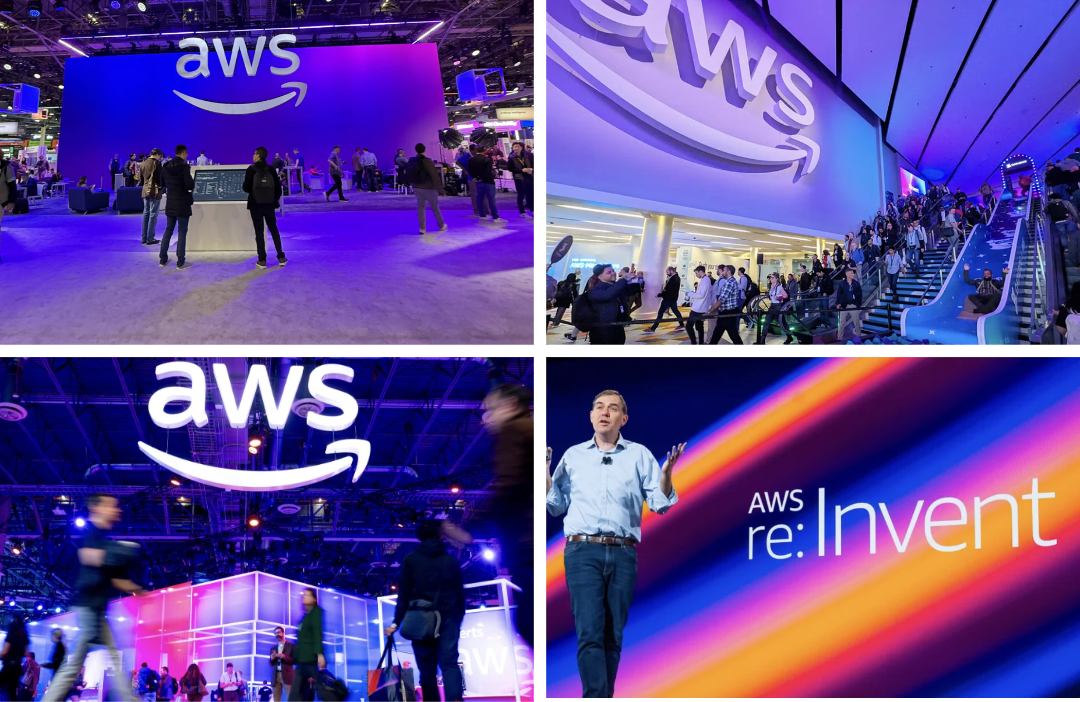 A few scenes from AWS re:Invent 2025 in Las Vegas.
On the way home, we did what we always do: compared notes. Different sessions, different conversations, and somehow we all landed on the same sentence.
re:Invent 2025 was the week AI moved from assistance to execution.That’s our read, not an AWS tagline. But it captured the mood in every room. Nobody was asking “which model should we use?” anymore. They were asking “how do we get AI to do useful work, reliably, inside the systems we already run?”
And for us, the biggest story wasn’t a single launch. It was operationalization: modernizing the workloads a business depends on, making its data usable for AI, and keeping everything reliable and cost-controlled once it’s live.
AI stopped talking and started working: the AWS re:Invent 2025 announcements
AWS backed the execution story with launches across agents, models, custom silicon, data and security. Here’s what caught our attention.
Model choice grew too: a bigger Amazon Nova 2 family, Nova Forge for building customized frontier models, and 18 more fully managed open-weight models in Bedrock. One fair note: the performance and cost gains in launch materials are AWS’s own claims, and results will vary by workload.
AWS is selling a stack, not a model
Step back from the individual launches and a pattern appears. AWS didn’t try to win on model capability alone. It laid out a connected stack for building and running enterprise AI:
Infrastructure
Trainium3, Graviton5 and AI Factories, for performance, cost and where AI is allowed to run.
Models
Nova 2, a wider set of third-party models, and new ways to customize them with proprietary knowledge.
Agent control
Bedrock AgentCore, for deploying, constraining and evaluating agents.
Task execution
Nova Act and the frontier agents, doing the actual work.
Data
S3 Vectors and enterprise data integrations, so AI can reach what a business already knows.
Trust and control
Policy controls, evaluations, security reviews and operational visibility, the counterweight to every gain in autonomy.
It wasn’t only an AI show
It would be easy to file re:Invent 2025 under “AI” and move on. But some of the most practical news was for the core cloud. Lambda Managed Instances and Lambda Durable Functions made it simpler to deliver applications and orchestrate longer-running workflows. EKS Capabilities and Database Savings Plans gave teams new ways to simplify operations and manage cost.
And for partners like us, AWS brought Partner Central into the AWS Management Console, with solutions, opportunities and Marketplace listings managed in one place. Small on stage, but it makes working together with AWS a lot smoother.
Three problems every team brought us
Here’s the honest part. The teams we met weren’t asking us for a bigger AI vision. They were asking about three very practical problems.
One honest boundary: this applies to data in FSx for ONTAP. Data sitting in an on-premises NetApp system still needs the right architecture, and sometimes a migration, to get there.
The hard part is running it
We came home with one conviction. Starting AI is easy. Running it is the job.AWS is adding powerful native capabilities at every layer. That doesn’t make the engineering around them less important. It makes it more important. So we lead with the workload, not the tool.
We work as one accountable team from Day 0 to Day 2. We get to know the workload and what the business depends on. We set the architecture, integrations and operating model. We decide which native AWS capabilities and existing tools should do what. We validate every change. And we stay to keep improving it after go-live.
Our customers run the workloads that can’t fail: silicon design against a tape-out date, simulation, risk, genomics and regulated data. For them, AI that acts on its own is a non-starter. So we hold ourselves to one rule.
AI proposes, people approve, code enforces. AI never changes an environment by itself. Every change is a Git pull request with a saved plan, an approval and a rollback, and every action leaves an audit trail.
AI Correlation Fabric (AICF, patent-pending) is how we make that delivery better. It pulls compute, GPUs, schedulers, licenses, storage and cost into one correlated picture, and it correlates and certifies the data before any AI sees it, so the AI starts from your real estate rather than a guess.
See you at AWS re:Invent 2026, December 1 to 3
We’re going back for the same reason we loved last year: the people. Six of us will be in Las Vegas, and we want to hear what’s actually hard about moving, modernizing and running HPC and AI on AWS, whether that’s semiconductor and EDA, engineering and CAE, AI and GPU workloads, or life sciences.
If you’d like to see how we work, here’s what we’re bringing:
AI Correlation Fabric, live
One correlated picture across a real estate: compute, GPUs, schedulers, licenses, storage and cost.
Ask. Review. Approve.
How a request like “I need 200 cores for CAE” becomes a reviewed, approved and deployed change, with no Terraform skills needed.
The Day 2 copilot
Root cause with evidence and a suggested fix, with your engineer approving every change.
Not ready for a full project? There are two easy ways to start: a two-week, read-only readiness assessment, where the map and the plan are yours to keep, or a proof of concept on your own workloads in about four weeks.
Oh, and we’re bringing a few characters we’d like you to meet. Keep an eye on our re:Invent page.
Your AWS re:Invent 2025 questions, answered
What Is AI Correlation Fabric?
The architecture behind connected operational context. Read → DebriefWhat Is an AI Readiness Assessment?
What we evaluate first, before a single line of AI gets built. Read → DebriefThe AI Control Gap Is a Foundation Problem
Why proving AI is safe depends on the foundation around the model. Read →Announcements are summarized as presented by AWS at re:Invent 2025; performance and cost claims in AWS launch materials are AWS’s own. OnStak figures come from our own AIOps work and proof of concept and will vary by environment.